Hydrometallurgy
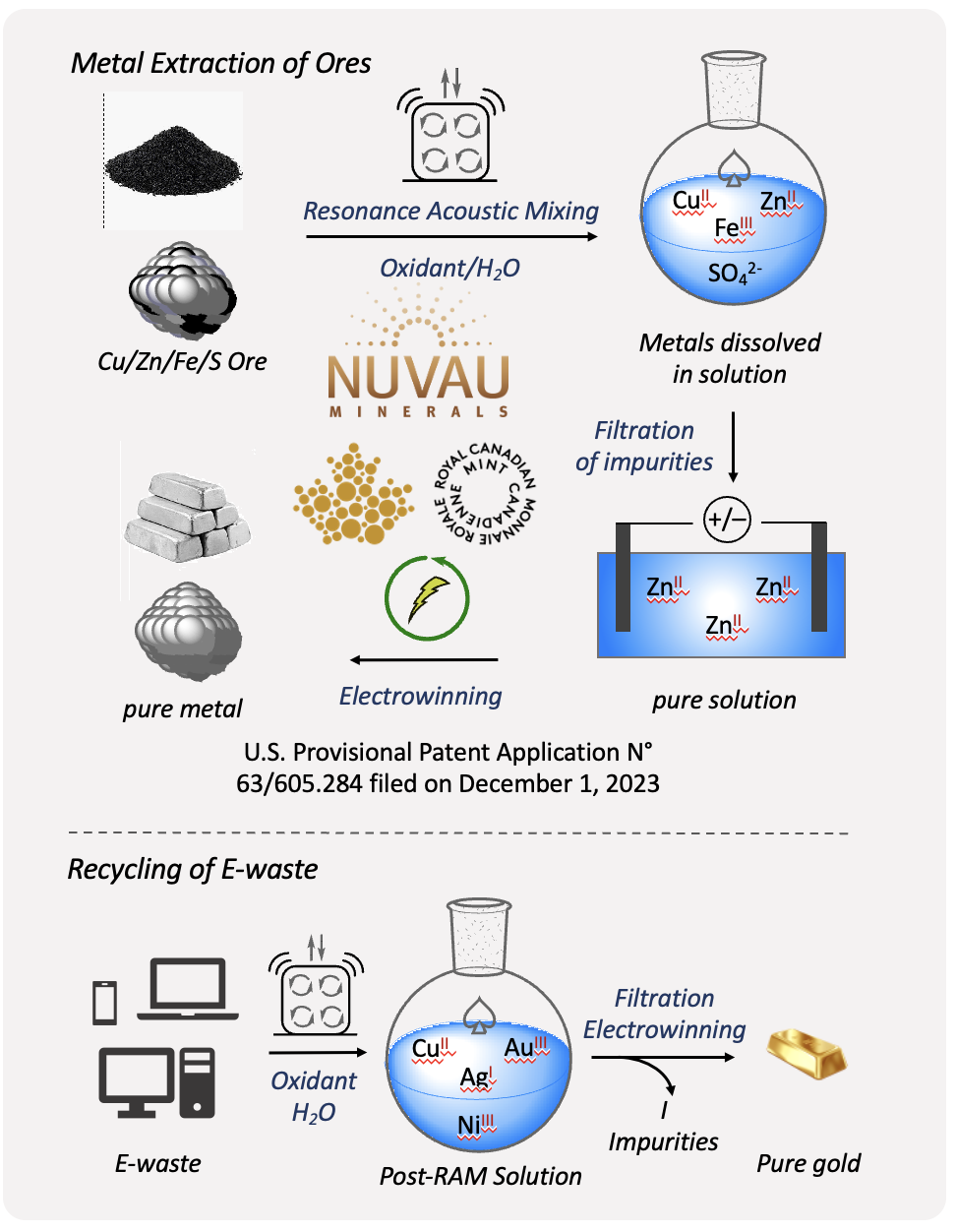
Resonance Acoustic Mixing (RAM) is an emerging mechanochemical technology in which a reaction vessel oscillates vertically at low frequencies. It is valued for its excellent mixing capabilities, low energy consumption and scalability. Due to its rapid, homogeneous mixing and scalability, RAM is currently employed in the pharmaceutical, defense, and polymer industries, where it is used to mix powders, pastes, slurries, or liquids on scales of up to 23,000 kg/hr in a continuous process.
Our group focuses on developing RAM-based processes for the hydrometallurgical extraction of critical and precious elements from various sources. Traditionally, hydrometallurgical processes involve dissolving metals into highly acidic solutions using strong oxidants in stirred batch conditions. When applied to metal extraction, the improved contact between ore particles and oxidants in RAM significantly enhances the dissolution rates of metals compared to stirring methods.
Our group currently work developing RAM-based processes in the field of hydrometallurgy in three main areas:
Sulfide minerals are the primary source of Cu and Zn worldwide, but current industrial processes still rely mainly on highly energy-intensive smelting techniques. We have demonstrated that RAM can be used as an environmentally friendly hydrometallurgical alternative to efficiently dissolve and recover Cu and Zn from ore samples.
In collaboration with the Royal Canadian Mint, we have patented a one-step purification RAM-based process to produce ultrahigh-purity precious metals from alloys.
Purification of base and precious metals from various waste sources, including discarded electronic components, automotive waste, and discarded jewelry, as an emerging urban mining RAM-based technology that promotes sustainable and efficient recycling methods. Our group is pioneering in the current critical metals industry, applying RAM-based technology. We examine these processes under mild conditions that enable the effective separation of plastics, as well as base and precious metals.